The Truth About Intermittent Fasting: What the Research Actually Shows
A balanced, research-first look at intermittent fasting — comparing 16:8, 5:2, and alternate-day fasting on evidence strength and practical difficulty, an honest assessment of where IF outperforms standard calorie restriction and where it does not, and a clear verdict on who it suits.
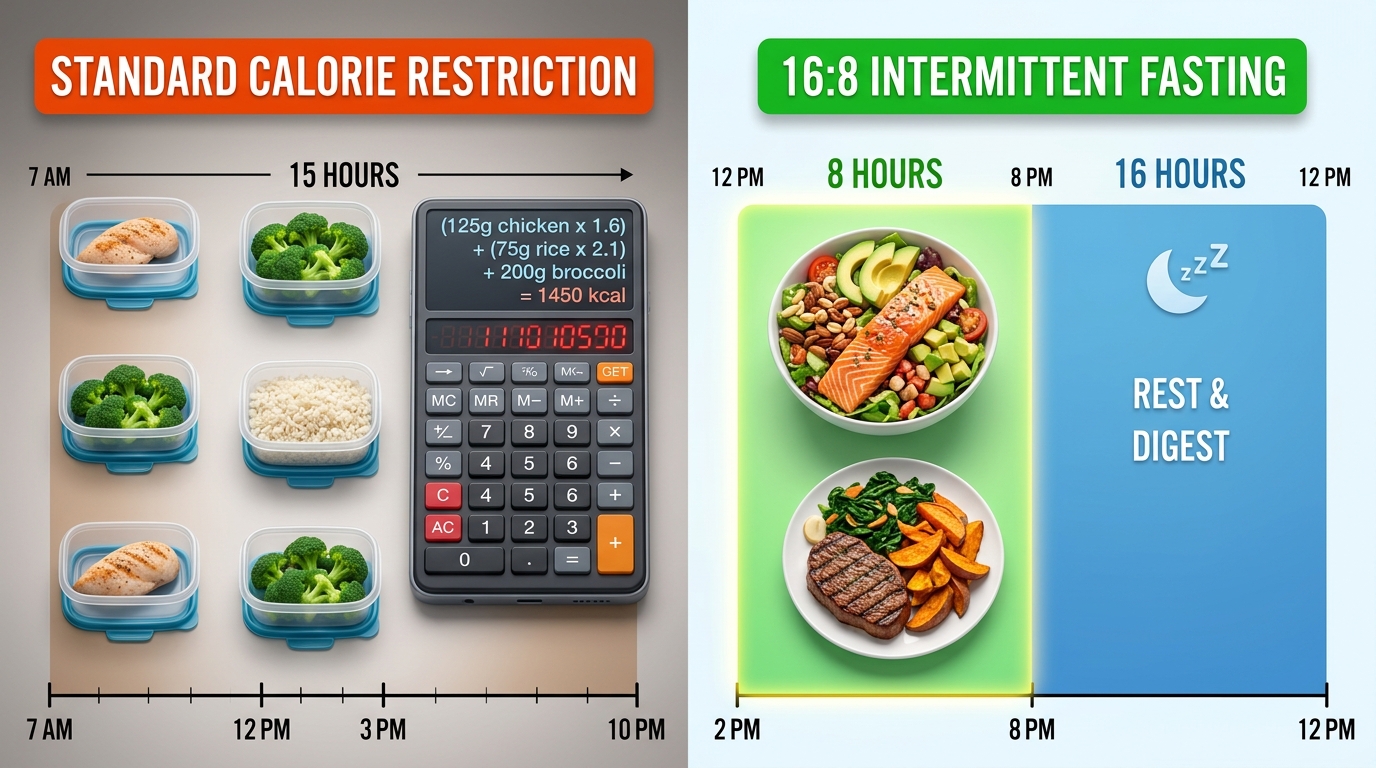
A large randomised controlled trial published in the New England Journal of Medicine in 2022 found that time-restricted eating (a form of intermittent fasting) produced no significant difference in weight loss compared to continuous calorie restriction when total caloric intake was matched — directly challenging the popular claim that 'when you eat matters as much as what you eat' [SOURCE: verify — Liu et al. NEJM 2022 or similar matched-calorie IF trial]. This is not fringe research — it reflects a pattern in recent intermittent fasting research that the earlier wave of enthusiastic studies did not always anticipate.
This guide covers what the intermittent fasting research actually shows — where the evidence is strong, where it is preliminary, and where popular claims outpace what the studies demonstrate. The goal is not to dismiss IF but to give you an accurate map of what it does and does not do, so you can decide whether it suits your situation.
Disclaimer: This article is for informational purposes only and does not constitute medical or nutritional advice. Intermittent fasting is not appropriate for everyone — including those who are pregnant, have a history of eating disorders, have diabetes, or are on certain medications. Consult a qualified healthcare professional before starting any significant dietary change.

What Intermittent Fasting Actually Is
Intermittent fasting is not a specific diet — it is a timing framework. It describes patterns of eating that cycle between periods of eating and periods of fasting. The main protocols in the research literature and popular practice are:
What the Research Genuinely Supports
For weight loss: intermittent fasting produces weight loss. This is consistent across the research literature. The more nuanced and more recent finding is that in randomised trials where total caloric intake is carefully matched between IF and continuous calorie restriction groups, IF does not produce meaningfully greater weight loss. The weight loss IF produces appears to operate primarily through the caloric restriction it induces — people eating within a restricted window tend to eat less. The timing itself adds limited independent benefit in controlled conditions [SOURCE: verify — multiple IF vs calorie restriction meta-analyses].
For metabolic markers: some studies show improvements in insulin sensitivity, fasting glucose, triglycerides, and blood pressure with IF protocols — independent of weight loss. These effects are most consistent in people with metabolic syndrome or pre-diabetes and in studies using early time-restricted eating (eating window earlier in the day, aligning with circadian rhythm) [SOURCE: verify — Sutton et al. Cell Metabolism 2018 early TRE study]. The effect size in healthy-weight individuals is modest.
For adherence: some people find IF protocols easier to maintain than daily calorie counting. This is real and meaningful — an eating pattern you sustain is always more effective than an optimal one you abandon. For these individuals, IF's effect on their weight and metabolic health may exceed what the matched-calorie research suggests, simply because they maintain it longer.

Where the Hype Outpaces the Evidence
Autophagy as a primary health benefit of IF: autophagy — the cellular cleaning process that removes damaged components — is activated during fasting. The claims that IF produces meaningful autophagy-based health benefits in typical 16-hour fast periods are extrapolated from animal studies and from research on longer fasting periods than most IF protocols involve. Human evidence on clinically meaningful autophagy from 16:8 fasting specifically is preliminary [SOURCE: verify].
IF and longevity: claims about IF extending lifespan in humans are extrapolated from animal studies, primarily in rodents. Human longevity research does not currently support the dramatic lifespan extension claims associated with calorie restriction and fasting in animal models.
Metabolic advantage beyond calorie restriction: multiple well-designed trials have now shown that when calories are matched, IF does not produce the superior metabolic outcomes that early enthusiasm predicted. The advantage appears to be adherence-based rather than mechanistic for most people.
Who IF Works Well For — And Who It Probably Does Not
Hypothetical example 1 (IF works): Nadia is a 34-year-old who finds traditional calorie counting tedious and stressful. She tries 16:8 by simply skipping breakfast and eating from noon to 8 PM. She does not track calories. She naturally eats less — two meals instead of three — and loses 8 kg over four months. She maintains the pattern without effort because it suits her natural appetite pattern. This is probably the most common IF success story: a structure that reduces intake without the cognitive overhead of tracking.

Hypothetical example 2 (IF does not work): Marcus is a 41-year-old who tries 16:8 but is intensely hungry by mid-morning and compensates at his noon meal and dinner by eating significantly more. At the end of four weeks his caloric intake has not changed and neither has his weight. He switches to simple portion reduction and consistent protein intake and begins losing weight. IF was not the right tool for his hunger pattern — not a character failing, just a mismatch between the protocol and his physiology.
The most honest summary of the current intermittent fasting research: it works about as well as standard calorie restriction for weight loss in matched comparisons. The difference is that some people find it easier to maintain — and for those people, it is an excellent tool. For others, it produces hunger-driven overconsumption or triggers disordered eating patterns, making it actively counterproductive.
Key Takeaways
- IF produces weight loss consistently — but primarily through the caloric restriction it induces, not through a timing mechanism that is independent of calories
- In matched-calorie trials, IF does not meaningfully outperform continuous calorie restriction for weight loss — recent large-scale RCTs have clarified this
- Early time-restricted eating (eating window aligned with morning/midday) shows the most consistent metabolic benefits independent of weight loss
- IF is a genuinely good tool for people who find it naturally easier to maintain than calorie counting; it is not the right tool for people prone to hunger-driven overconsumption
- Autophagy and longevity claims extrapolate primarily from animal research — the human evidence for these specific benefits from typical IF protocols is preliminary

Frequently Asked Questions
Will intermittent fasting slow my metabolism?
Short-term fasting of 16–24 hours does not meaningfully reduce metabolic rate — some research suggests it may modestly increase it through noradrenaline release. Prolonged severe caloric restriction can reduce metabolic rate over time, but this is a caloric restriction effect, not an IF-specific one. The 'starvation mode' concept as applied to typical IF protocols is not supported by the research literature.
Is IF safe for women specifically?
Some research suggests women may be more sensitive to the hormonal effects of significant caloric restriction, with potential impacts on menstrual regularity and reproductive hormones at more aggressive protocols. The 16:8 protocol is generally considered safe for most healthy women; more aggressive restriction (OMAD, extended fasting) has more limited research in women specifically. Women who are pregnant, trying to conceive, or breastfeeding should not undertake IF without medical guidance.
Does coffee break a fast?
Black coffee contains negligible calories and does not meaningfully disrupt the fasting state for metabolic purposes. It does not break an IF fast by any clinically relevant definition. Coffee with milk, cream, or sugar adds calories that reduce the fasting period's caloric deficit. Technically whether these break a 'fast' depends on which definition of fasting you are using; for weight loss purposes, a small amount of milk in coffee is unlikely to be the variable that determines outcome.
What should I eat during the eating window?
IF is a timing framework, not a dietary prescription. The research consistently shows that the composition of the diet within the eating window matters — protein intake is particularly important for preserving muscle mass during caloric restriction. A diet adequate in protein (0.7–1g per pound of body weight for most active adults), with vegetables, whole grains, and healthy fats, produces better outcomes than IF with an unrestricted processed-food eating window.
How long does it take for IF to produce results?
Most clinical trials show measurable weight loss within 4–8 weeks of consistent IF practice, comparable to the timeline for calorie restriction. Metabolic marker improvements (insulin sensitivity, triglycerides) may appear within 4–12 weeks. The key variable is whether the protocol is being consistently maintained — an IF approach that is abandoned on 3 days per week will not produce the outcomes shown in compliance-controlled research.


