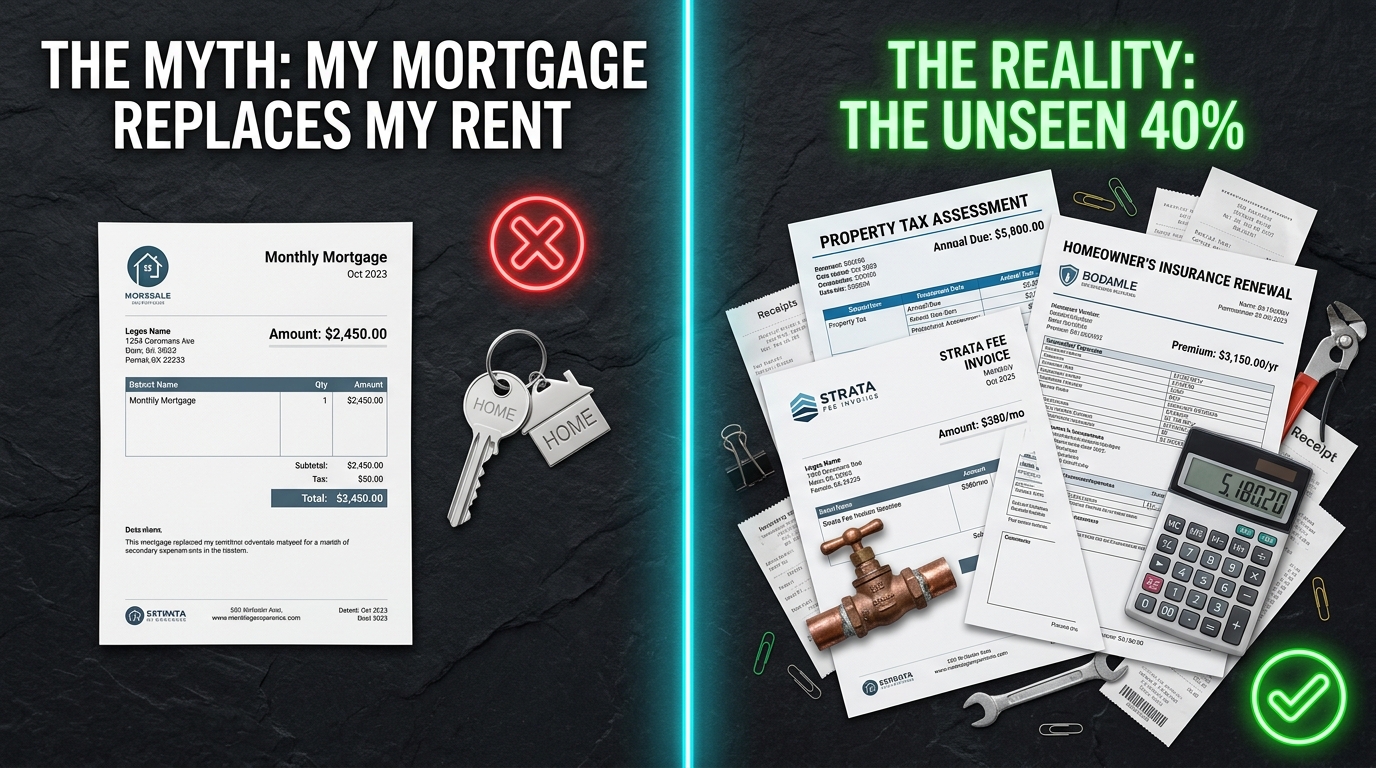
5 Hidden Costs of Homeownership That First-Time Buyers Almost Always Miss
A practical breakdown of the 5 most consistently underestimated hidden costs of buying a home — from the 1% maintenance rule and property taxes to strata fees, insurance escalation, and deposit opportunity cost — with a true annual cost table.
First-time buyers typically underestimate their total first-year homeownership costs by 30–40% beyond what they planned for at purchase [SOURCE: verify — homeownership cost surveys, e.g., Bankrate, Zillow, or similar]. Not because they are careless, but because the mortgage payment is the only number that gets talked about prominently. The mortgage is the visible cost. The hidden costs of buying a home are the ones that arrive quietly across the first 12 months and collectively produce financial stress that many new homeowners do not see coming.
This guide covers the five hidden costs of homeownership most consistently missed — not to discourage buying, but to ensure that when you buy, you are prepared for what actually owning a home costs, not just what the listing price and mortgage payment suggest.
Disclaimer: This article is for informational purposes only and does not constitute professional financial or legal advice. Costs vary significantly by location, property type, and individual circumstances. Always consult qualified professionals before purchasing property.

Hidden Cost 1 — Maintenance and Repairs: The 1% Rule and Why It Undershoots
The standard rule of thumb is to budget 1% of the home's value per year for maintenance and repairs. On a $400,000 home, that is $4,000 annually — an amount most first-time buyers do not have set aside in addition to their deposit and closing costs.
What first-time buyers consistently underestimate is not the big costs — it is the relentless frequency of small ones. A broken fence, a blocked drain, a failed appliance, a leaking tap, grout that needs replacing — none of these is catastrophic individually, but they arrive throughout the year without warning and without any mechanism for budgeting individually. The 1% rule attempts to account for this aggregate.
The contrarian caveat: for older properties (30+ years), properties in extreme climate zones, and homes with older roofing, HVAC systems, or plumbing, 1% significantly undershoots. Research on homeownership costs suggests 1.5–2% is more accurate for older properties [SOURCE: verify — home maintenance cost data by property age]. And the distribution is not smooth: major systems (roof, HVAC, hot water system) tend to fail in clusters when the property was built in a single construction phase and all major components age simultaneously.
The practical implication: a home maintenance fund — separate from your emergency fund — should be established before or immediately after purchase and funded consistently from day one. It will look unnecessary for months and then be essential without warning.
Hidden Cost 2 — Property Taxes, Council Rates, and Municipal Levies
Property taxes (US), council rates (Australia, UK), and municipal taxes (Canada) are unavoidable annual costs of homeownership that vary enormously by location and are frequently underestimated at purchase — particularly when buyers focus on the mortgage payment in isolation.
In the US, property tax rates range from under 0.3% of assessed value annually in some states to over 2% in others — a difference of $3,000–$20,000+ on a $500,000 home depending on location [SOURCE: verify — Tax Foundation property tax data by state]. In Australia, council rates vary by local government area. In the UK, council tax bands are based on property value estimates from 1991 and have become disconnected from current market values in some areas.
Critically: property taxes change. A home purchased at a low tax rate in an area undergoing development or gentrification may face reassessment. Many US states allow property tax appeals — worth knowing before assuming the rate is fixed.
Hidden Cost 3 — Strata, Body Corporate, and HOA Fees
For apartments, condominiums, townhouses, and many planned developments, there is typically a mandatory ongoing fee — called strata levies in Australia, body corporate fees in some markets, and homeowners association (HOA) fees in the US — that covers shared building maintenance, insurance, and management.
These fees range from modest to very significant. Basic strata levies in a low-rise building might be $1,500–$3,000 per year. High-rise buildings with concierge, gym, and pool facilities can run $6,000–$15,000 annually [SOURCE: verify — strata and HOA fee data]. In the US, HOA fees average approximately $200–$300 per month in communities that have them [SOURCE: verify — HOA fee national data].

The hidden element within strata fees: special levies. When a building's sinking fund is inadequate for a major repair — a new roof, elevator replacement, external cladding — the body corporate can issue a special levy requiring immediate additional payment from all owners. These can be thousands of dollars with relatively short notice. Request the body corporate's sinking fund report before purchasing any strata property.
Hidden Cost 4 — Insurance Escalation Over Time
Homeowners insurance is a known cost — buyers typically factor in the first year's premium. What first-time buyers almost never factor in is how dramatically that premium can escalate after the first year, particularly in regions increasingly affected by climate-related risks.
Insurance premiums for homes in flood plains, wildfire zones, coastal areas, and regions with increasingly frequent severe weather events have risen significantly across the US, Australia, and the UK over the past five years [SOURCE: verify — insurance premium escalation data by risk zone]. Some insurers have withdrawn from specific markets entirely. In some US states, homeowners have found their existing insurer non-renewed after a single claim, requiring placement in a state insurer of last resort at significantly higher cost.
Before purchasing: get insurance quotes from multiple providers, not just the one your mortgage broker recommends. Research whether the property's location has seen insurer withdrawals or premium increases in recent years. If the property is in a flood plain, the cost of mandatory flood insurance may not be reflected in the seller's current premium if they purchased before recent escalations.
Hidden Cost 5 — The Opportunity Cost of the Deposit
The hidden cost that surprises people most, because it never appears on any invoice, is the opportunity cost of the capital tied up in the deposit and the equity built over time. A $100,000 deposit invested in a broad-market index fund at historical average returns of approximately 7–10% annually would produce $700,000–$1,700,000 over 20 years [SOURCE: verify — compound calculator]. That same $100,000 as a property deposit produces a different kind of return — price appreciation, avoided rent, tax benefits in some jurisdictions — but the comparison is real and rarely made explicit in homeownership discussions.
This does not mean renting is categorically better than buying — rent itself has an opportunity cost (money paid with no asset accumulation). It means the financial comparison between renting and buying is genuinely complex, and the deposit represents a significant capital allocation with an opportunity cost that should be acknowledged in any full accounting of homeownership costs.
Hypothetical example: Marcus and Priya buy a $550,000 apartment. Their mortgage payment is $2,800 per month. In year one they are surprised to find they have also spent: $3,200 on repairs (hot water system failure, plumbing issue, garden), $5,800 in council rates and building insurance, $4,200 in strata levies (plus $800 special levy for lobby renovation), and an insurance premium that has risen 35% on renewal. Total additional costs year one beyond mortgage: $14,000. They did not budget for this. Neither figure appeared in their pre-purchase financial planning.
Key Takeaways
- Budget 1–2% of the home's value annually for maintenance and repairs — not 0%, and more for older properties or extreme climates
- Property taxes and council rates are unavoidable, location-variable, and can change after reassessment — research actual current rates, not estimated ones
- For strata properties, request the sinking fund report before purchase — an underfunded sinking fund means future special levies
- Insurance premiums are not fixed — research risk-zone trends in the area before assuming year-one quotes will hold
- The opportunity cost of the deposit is a real cost that should appear in any honest buy-vs.-rent comparison, even if it never appears on an invoice
Frequently Asked Questions
How much should I have saved beyond the deposit before buying?
Financial advisors commonly suggest having 3–6 months of total housing costs (mortgage plus all regular property expenses) in an accessible reserve in addition to the deposit and closing costs. This buffer covers the first year's maintenance surprises, the gap between possession and your first income post-settlement, and any utility connection or setup costs not accounted for in the purchase price.
What is a sinking fund in strata property?
A sinking fund is the body corporate's reserve account for major capital works — roof replacement, elevator maintenance, external painting, structural repairs. A healthy sinking fund with adequate reserves means special levies are unlikely. An underfunded fund means existing and future owners share the cost of capital works as they arise, often at short notice. Request the sinking fund balance and the most recent depreciation schedule before purchasing any strata property.
Is the 1% maintenance rule reliable for new builds?
New builds typically have lower maintenance costs in the first 5–10 years because major systems are under builder warranty and have not yet aged. The 1% rule applies more accurately from years 7–15 onward as systems age and warranties expire. New build owners can budget at 0.5% in the first few years but should ramp up to 1–1.5% as the property ages and hold the difference in reserve for when it is needed.
Can property taxes be appealed?
In most US states, property tax assessments can be formally appealed if you believe the assessed value is higher than market value — a common situation in markets where valuations have lagged price declines. The process involves filing a formal appeal, providing comparable sales data, and sometimes attending a review hearing. Success rates for well-documented appeals are meaningful. In the UK and Australia, equivalent processes exist for council tax banding and rates assessments respectively.
How do I find out if a property's insurance costs are likely to escalate?
Research the property's flood zone classification (FEMA flood maps in the US, state-based flood mapping in Australia and UK). Check whether major insurers are still actively writing policies in the area. Ask the current owner for their insurance history and whether premiums have changed significantly in the past 3 years. In areas where insurer withdrawal is occurring, multiple comparison quotes before purchase will reveal whether competitive pricing is still available.