The Real Math Behind "Pay Yourself First" — And How to Make It Work on Any Budget
The compound growth math behind pay-yourself-first budgeting — actual dollar comparisons, why saving what's left never works behaviourally, and how to automate the habit at any income level.
Here is the compound growth calculation most financial guides leave out. Someone who saves $300 per month starting at age 25 and invests it in a broad-market index fund at a historical average return of 7% annually will have approximately $737,000 by age 65. Someone with the same income who waits until 35 to start and contributes $300 per month for the same number of years will have approximately $340,000 — less than half — despite contributing for 30 years vs. 40. The decade of delay costs them $397,000. That is not an abstraction. That is the real math behind pay yourself first budgeting [SOURCE: verify — compound interest calculator at 7% annual return].
This guide delivers that math in full and then explains the system for making the principle work at any income level — including the honest acknowledgement of when it cannot work and what to do instead.

What 'Pay Yourself First' Actually Means
The phrase is widely repeated and rarely explained. It means: before you pay any discretionary expense, before you buy groceries beyond essentials, before any lifestyle spending — transfer a predetermined amount to savings or investment. The 'yourself' is your future self. The 'first' means before everything else, not after bills and spending reveal what is left over.
The critical distinction from 'save what is left': saving what is left has never worked reliably for most households because there is almost never anything left. Parkinson's law applies to money as reliably as it applies to time — spending expands to fill available income. The reason 'save what's left' fails is not discipline; it is that the decision is made at the end of the month when the money has already been spent on things that felt necessary or reasonable at the time.
Pay yourself first budgeting removes the decision entirely. The money moves before you see the balance. You adapt your spending to what remains. This is behaviourally easier than it sounds — research on automatic saving consistently shows that people adapt to a lower take-home balance with far less difficulty than they anticipate [SOURCE: verify — Thaler and Benartzi Save More Tomorrow research].
The Real Math — What the Numbers Show
The power of pay yourself first is not in the savings rate — it is in the time the savings spend compounding. Here is the same principle across three income levels and two starting ages:

The non-obvious insight most pay-yourself-first guides miss: the growth column dwarfs the contribution column in every scenario starting at 25. You are not building wealth with your savings — you are building wealth with time. The savings are just the entry fee for time to do its work. This is why starting small and early consistently outperforms starting large and late. [SOURCE: verify — all figures are illustrative at 7% annualised return; actual returns vary and are not guaranteed]
Disclaimer: This article is for informational purposes only and does not constitute professional financial advice. Consult a qualified financial advisor for advice specific to your situation.
How to Determine Your 'First' Amount
The correct pay yourself first amount is the highest sustainable amount — not the highest aspirational amount. An automated transfer of $200 per month that runs uninterrupted for 20 years builds more wealth than a planned $500 per month that gets paused when money is tight and gradually abandoned.
Calculate it in reverse: list your fixed, non-discretionary expenses (rent, utilities, minimum debt payments, insurance, food). Subtract from your take-home income. Whatever remains is what you have to allocate between savings and discretionary spending. A common starting point is 10% of take-home income — but the right number is whatever leaves you solvent and does not require you to override the transfer in normal months.
The honest lower bound: below a certain income level relative to fixed costs, there is genuinely nothing to save first. Telling someone paying $1,600 in rent on a $2,200 take-home to 'automate 10% savings' is useless advice. At that income-expense ratio, the priority is increasing income or reducing fixed costs — not a savings rate percentage. Pay yourself first only functions when discretionary income exists above essential expenses.
Hypothetical example: Nadia earns $3,800 per month take-home. Fixed expenses: $2,400. She sets up an automatic transfer of $300 on payday to a dedicated savings account, leaving $1,100 for discretionary spending. She does not notice the $300 missing after the first two months. After 12 months she has $3,600 saved — more than she had managed to save in the previous three years combined using the 'save what's left' approach.

How to Automate It
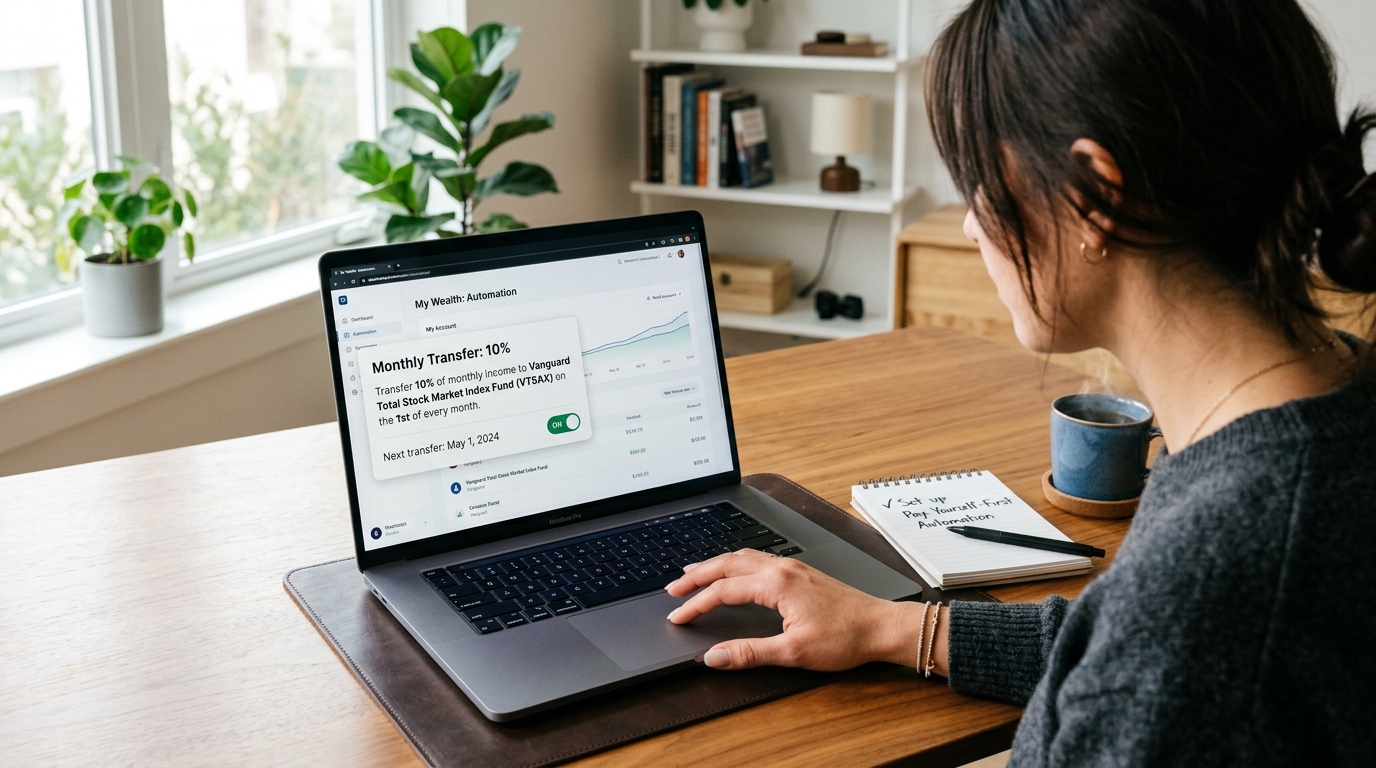
Set up a standing order or automatic transfer from your main account to a separate savings or investment account for the day your income arrives — not two days later, not at month end. The same day. This exploits the same psychological mechanism as employer pension contributions: money you never see in your spendable balance is money you do not miss.
The account it goes into matters: a savings account within the same bank that is a click away undermines the friction that makes the system work. A separate institution, ideally a high-yield savings account or investment platform, adds the resistance that prevents casual raiding of the fund. Out of sight, meaningfully harder to access on impulse, still accessible in a genuine emergency.
Hypothetical example 2: Marcus has tried to save for three years without success using the 'save what's left' approach. He opens an account at a different bank, sets a $150 automatic transfer for the day his salary arrives, and deliberately does not install that bank's app on his phone for the first three months. At month four he checks: $600 saved. At month eight: $1,200. He increases the transfer to $200. The system works because he built the friction in deliberately.
Scaling the Amount Over Time
Once the habit is established, the most effective scaling strategy is to increase the automatic amount by a fixed percentage whenever income increases — before the lifestyle adjustment absorbs the raise. A 30% savings allocation of any salary increase means your savings rate improves each time you earn more, without your standard of living declining. The remaining 70% still increases your take-home.

Key Takeaways
- The decade between starting at 25 and starting at 35 with identical contributions produces roughly half the final balance — time in the market is the primary wealth-building variable, not the savings amount
- Save what's left fails behaviourally because spending fills available income — automation removes the decision before the spending opportunity arises
- The right first amount is the highest amount that is sustainable without override in normal months — consistency over many years beats a higher rate that gets abandoned
- The savings need to go to a separate, slightly inconvenient account — friction is a feature, not a bug
- Allocate a percentage of every raise to savings before the lifestyle adjustment absorbs it
Frequently Asked Questions
What if I can only save $50 per month?
Start with $50. The habit matters more than the amount at the beginning. $50 per month at 7% annual return over 30 years grows to approximately $57,000 — and the habit it builds typically leads to increases as income grows. The worst financial outcome is waiting until you can 'afford to save more' — which usually means never starting. The best is starting with whatever is honest and increasing from there.
Should I pay off debt before saving?
For high-interest debt (credit cards above 15% APR), paying it off first is mathematically superior because the guaranteed 'return' of eliminating 20% interest exceeds most investment returns. For low-interest debt (mortgage, student loans below 6%), saving simultaneously often makes mathematical sense. A practical middle ground: a small automatic savings amount (even $50) while aggressively repaying high-interest debt — the habit is preserved even if the amount is minimal.
Does this work for variable income earners?
Yes — with adjustment. For freelancers and commission earners, the fixed transfer approach can create cash flow problems in low-income months. An alternative: set a percentage rather than a fixed amount, and transfer it within 48 hours of each income receipt rather than on a fixed calendar date. The principle — save before you spend — applies equally; the mechanics adapt to irregular cash flow.
Where should the 'first' money go?
The destination depends on your goals and situation. Emergency fund if you have less than three months of expenses saved (use a high-yield savings account). Employer-matched pension or 401(k) if you have match available and an emergency fund (the match is an immediate 50–100% return). After those: tax-advantaged investment accounts (ISA, Roth IRA, TFSA depending on country) before taxable accounts.
What is the difference between pay yourself first and a budget?
A budget allocates spending across categories and requires ongoing decision-making and compliance. Pay yourself first is a single automated decision made once that does not require daily or monthly compliance. Most people who struggle with budgets find pay yourself first easier to maintain because the cognitive load is near-zero after setup. They are not mutually exclusive — but for people who have abandoned budget systems repeatedly, automation without category tracking is often the more durable approach.